Menlo Park · Atherton · one builder
About fifty, or fewer than twenty.
Joseph Eichler built in both towns, four miles apart. In Menlo Park he built small tracts of repeated plans on quarter-acre lots, from 1950 to the early 1970s. In Atherton he built one-offs on acres, and then stopped. Almost everything else follows from that.
Per Eichler Network
The Boyenga Team’s count
1 acre against 7,000 sq ft
The short version
Tracts against one-offs.
Menlo Park has roughly fifty Eichlers, in five small clusters, built as repeated plans a builder could sell over and over. Atherton has fewer than twenty, all of them custom-scale, in a development Eichler abandoned before he finished it and a small later cluster on two streets.
That difference in kind is why the two towns read so differently to anyone trying to buy, sell or keep one.
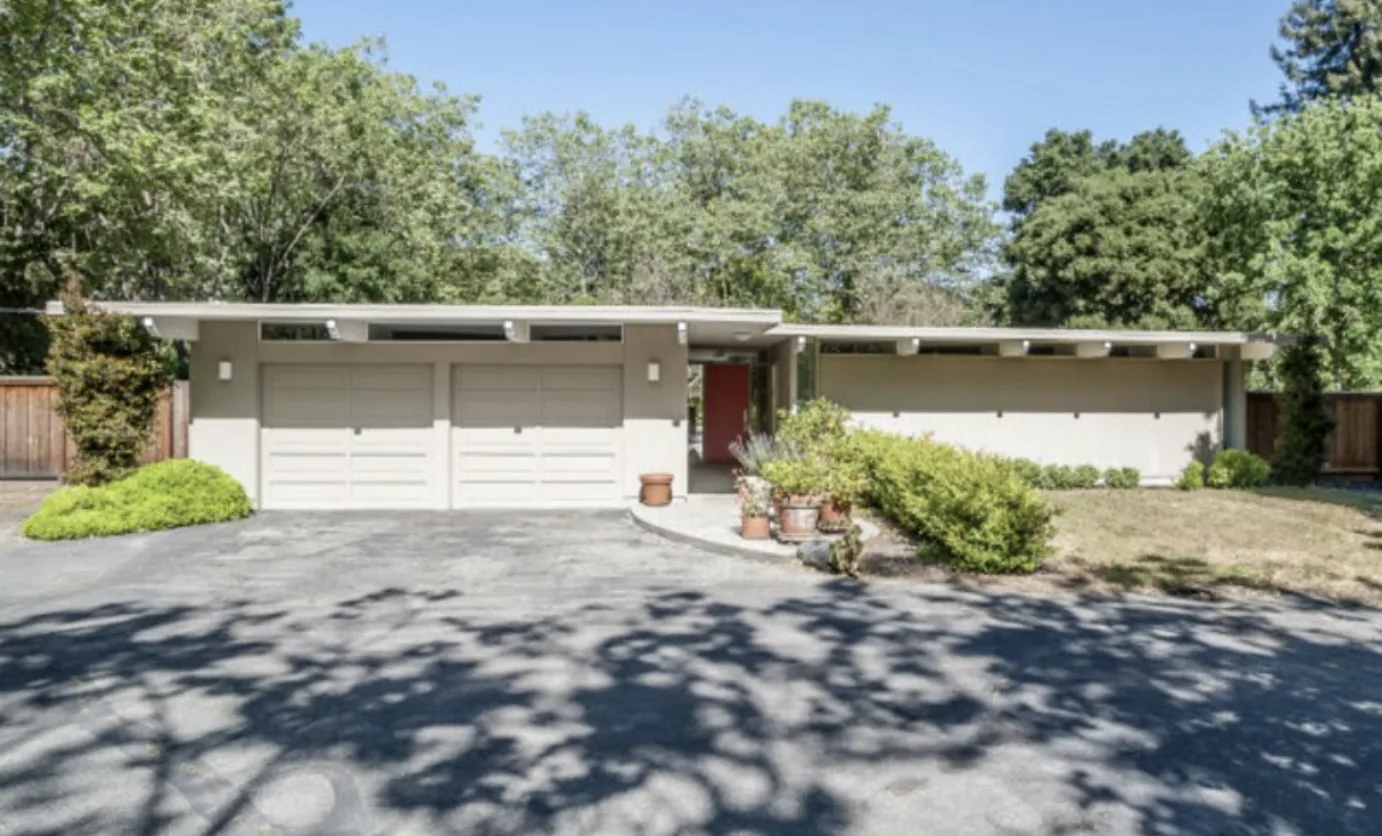
- Eichlers built
- ~50 in Menlo Park · fewer than 20 in Atherton
- Years
- 1950–early 1970s · 1951–1960
- How they were built
- Repeated tract plans · one-off customs
- Typical lot
- 7,000–10,000 sq ft · about an acre
- Architects
- Anshen & Allen, Jones & Emmons, Claude Oakland · Anshen & Allen
- Atriums
- None documented · Plan 37, drawn for Atherton
Sources: Eichler Network, “Menlomorphosis” (CA-Modern, Winter 2014) and “Menlo Eichlers on the Edge”; our own count for Atherton. The Atherton register.
Menlo Park
Five clusters, none of them large.
Stanford Gardens, on Evergreen, Oakdell and Lemon streets, is the earliest — sources date it 1949, January 1950, or 1950–51 — and it predates Eichler’s hiring of name architects. Eichler Network attributes the houses to a designer known only as Castor. They were about 1,650 square feet, three bedrooms and two and a half baths, with shed roofs and clerestory glass, and the sources give the price as either $19,500 or $21,000. Eichler Network calls it the first Eichler development with radiant heat. Oakdell Park, 1952, was sixteen houses in five models on Olive, Oakdell, Middle and Magnolia — and it is the one tract in Menlo Park credited to both Anshen & Allen and Jones & Emmons. They started at 1,300-odd square feet and $25,000. Stanford Avenue is three Claude Oakland models on a hidden court, built in the early 1970s — among the last houses Eichler built anywhere. Peninsula Way is seven houses of 1954–55, up to 2,800 square feet on half- to three-quarter-acre flag lots, with landscapes by Thomas Church. It is the one group that approaches Atherton scale — and, as below, it is not in Menlo Park at all. Berkeley Avenue and its surroundings hold a handful more. Eichler Network counts Peninsula Way and Berkeley Avenue together at about ten houses; one 1951 house there is the last intact survivor of a group of four. We keep a separate site for Menlo Park’s Eichlers, tract by tract.A wrinkle worth knowing
Peninsula Way is not in Menlo Park.
The seven Peninsula Way houses carry a Menlo Park mailing address, but they sit in Menlo Oaks, which is unincorporated San Mateo County. The city’s zoning, its historic-site ordinance and its heritage-tree rules do not reach them; county rules do, and Eichler Network reports that the unincorporated pockets have weaker tree protection than Menlo Park, Palo Alto or Atherton.
So the Menlo Park group that most resembles Atherton — big houses, big lots, mature oaks — is also the one with the least protecting it. Anyone comparing the two towns on a map should check which side of the city line a house is actually on.
The lot
An acre, or a quarter of one.
This is the number that explains most of the rest. Atherton’s minimum lot on level ground is one acre — 43,560 square feet, with sixty-foot front and rear yards. Menlo Park’s Eichler tracts sit in ordinary single-family districts: R-1-S, where the minimum is 10,000 square feet, covers Stanford Gardens, and R-1-U, where it is 7,000, covers Oakdell Park.
On the ground the Stanford Gardens lots on Evergreen Street are recorded at almost exactly 10,010 square feet each — the uniformity is the subdivision’s signature. Joe Eichler’s own house in Atherton sits on 39,123.
The other structural difference: Atherton has no commercial zoning at all — no shops, no restaurants, no grocery. Menlo Park has Sand Hill Road and Meta’s headquarters.
The atrium
Menlo Park is too early for it.
The feature most people picture in an Eichler is largely absent from Menlo Park, and the reason is chronology. Eichler Homes did not put the word “atrium” on a plan until 1957, or market it until 1957–58. Stanford Gardens (1950–51), Oakdell Park (1952) and Peninsula Way (1954–55) all predate that, and no source describes an atrium in any of them.
Atherton is the other end of that story. Anshen & Allen’s Plan 37, of August 1951 — an unroofed court closed on all four sides — was drawn for the upscale Lindenwood houses, six years before the word was used, and it was built here, at 73 Hawthorne Drive. The brochure page that prices it at $47,500 is on this site.
If you own a Menlo Park Eichler and someone has told you it has an atrium, it is worth checking what they actually mean — a courtyard added later is a different thing from a plan built around one.
Preservation
A better ordinance, the same outcome.
On paper Menlo Park protects its midcentury houses far better than Atherton does. Under chapter 16.54 of its code, a landmark designation can be started by the owner, by the City Council, or by a civic group, a public agency or an interested citizen — no owner consent required — and the Planning Commission can suspend a demolition for 180 days, which the Council can extend by another 180.
In Atherton, § 8.15.210(A) reserves that entirely to the owner. Nobody else may put a house forward, and an undesignated house has no demolition review at all.
And yet the outcome is the same. Menlo Park’s designated historic resources are a VA campus, a handful of older houses and two churches; no Eichler is among them, and the city has acknowledged it has no complete inventory of houses that might qualify. In August 2025 its Planning Commission voted 6–0 to permit the demolition of 1611 Oakdell Drive — one of Oakdell Park’s sixteen, the house Eichler Network had profiled as the tract’s original survivor, panelled in Philippine mahogany. The minutes record a discussion of trees, setbacks and neighbourhood fit. They do not mention that it was an Eichler.
A stronger ordinance that nobody has pointed at an Eichler protects exactly as much as a weaker one. What protects these houses in either town is an owner who wants them, and a sale run to find another one.
What they sell for
Figures, dated and attributed.
Menlo Park Eichler sales, from public records: 961 Peninsula Way, 2,010 square feet on 0.46 acre, $5,360,000 in June 2025. 805 Evergreen Street, 2,705 square feet on a 10,010-square-foot lot, $5,250,000 in October 2025. 645 Evergreen Street, 2,000 square feet, $4,800,000 in July 2022. 1611 Oakdell Drive, 1,610 original square feet, listed at $4,200,000 in January 2025 and sold — then approved for demolition seven months later.
In Atherton, we listed 19 Irving Avenue at $6,385,000 in March 2024, and 47 Placitas Avenue was listed by another brokerage at $4,788,000 the same month.
Per square foot the two towns are closer than the headline prices suggest — the Menlo Park sales above work out between roughly $1,900 and $2,700 a foot. What Atherton adds is land: an empty Atherton acre has sold for $9.5 and $10.7 million, which is the pressure every Atherton Eichler lives under and the reason so few are left.
We do not blend these numbers or quote Redfin figures, and we give each one its date.
Which is harder to keep
The honest answer.
Menlo Park’s Eichlers are ordinary houses on ordinary lots, so the replacement is a bigger house — Eichler Network describes spec builders replacing them with houses up to three times the size. There are enough of them that losing one is a loss to a street rather than to a record.
Atherton’s are one-offs, and the replacement is not a bigger house but an estate: the land alone is worth more than the house on almost any arithmetic. There are so few that each one lost takes a meaningful share of what exists with it. Five already have gone.
If you own one in either town, the practical lesson from both is the same, and it is not about the code. Document the house, decide before you list whether you are selling a house or a lot, and market it to the buyer you actually want. That is what we did with Joe Eichler’s own.
Questions we get asked
The ones that come up.
- Which town has more Eichlers, Menlo Park or Atherton?
- Menlo Park, by a wide margin. Eichler Network has put Menlo Park at about fifty since 2014. Fewer than twenty were ever built in Atherton, and Eichler Network counted seven still standing.
- Are Menlo Park Eichlers cheaper than Atherton’s?
- In total price, usually — recent Menlo Park Eichler sales have run from roughly $4.8 to $5.4 million, against a $6,385,000 list on Joe Eichler’s own house in Atherton. Per square foot the gap is much narrower. The difference is mostly land.
- Do Menlo Park Eichlers have atriums?
- No documented ones. The Menlo Park tracts were built from 1950 to 1955, and Eichler Homes did not market the atrium until 1957–58. The early courtyard plan, Anshen & Allen’s Plan 37 of 1951, was drawn for Atherton.
- Is Peninsula Way in Menlo Park?
- It has a Menlo Park address but sits in Menlo Oaks, unincorporated San Mateo County. The city’s zoning, preservation ordinance and tree rules do not apply there.
- Which town protects its Eichlers better?
- Menlo Park’s ordinance is stronger on paper — anyone may seek a designation and a demolition can be suspended for up to a year — but no Eichler there is designated, and in August 2025 the city approved the demolition of one of Oakdell Park’s sixteen. In practice neither town protects an undesignated house.
What we can do for you
Things worth asking us for.
Is it an Eichler?
Send us two photographs.
The living-room ceiling and the back wall settle it most of the time. With fewer than twenty ever built in Atherton, every one we can confirm is worth recording — for you, for your buyer, and for the town.
No cost and no obligation. If it is not an Eichler we will say so rather than guess.
If you are trying to buy one
Seven are standing. They almost never sell.
An Atherton Eichler comes up once in years, and when one does the buyer who gets it is almost always the one who was already known to the seller’s agent. Tell us what you are looking for and we will tell you, honestly, whether it exists.
Talk to us
Whichever side of the line you are on.
We work both towns and keep a site for each. If you own an Eichler in Menlo Park, Menlo Oaks or Atherton, we will tell you what it is, what it is worth as a house rather than a lot, and what the rules where you stand actually allow.
Where to go next
Read these three.
The rest of the story