Joseph L. Eichler · 1900–1974
The builder who hired architects.
A New Yorker in the family dairy business who rented a Frank Lloyd Wright house during the war, became a builder at forty-seven, and put more than eleven thousand modern houses into California.
Plus three in New York
Over discrimination
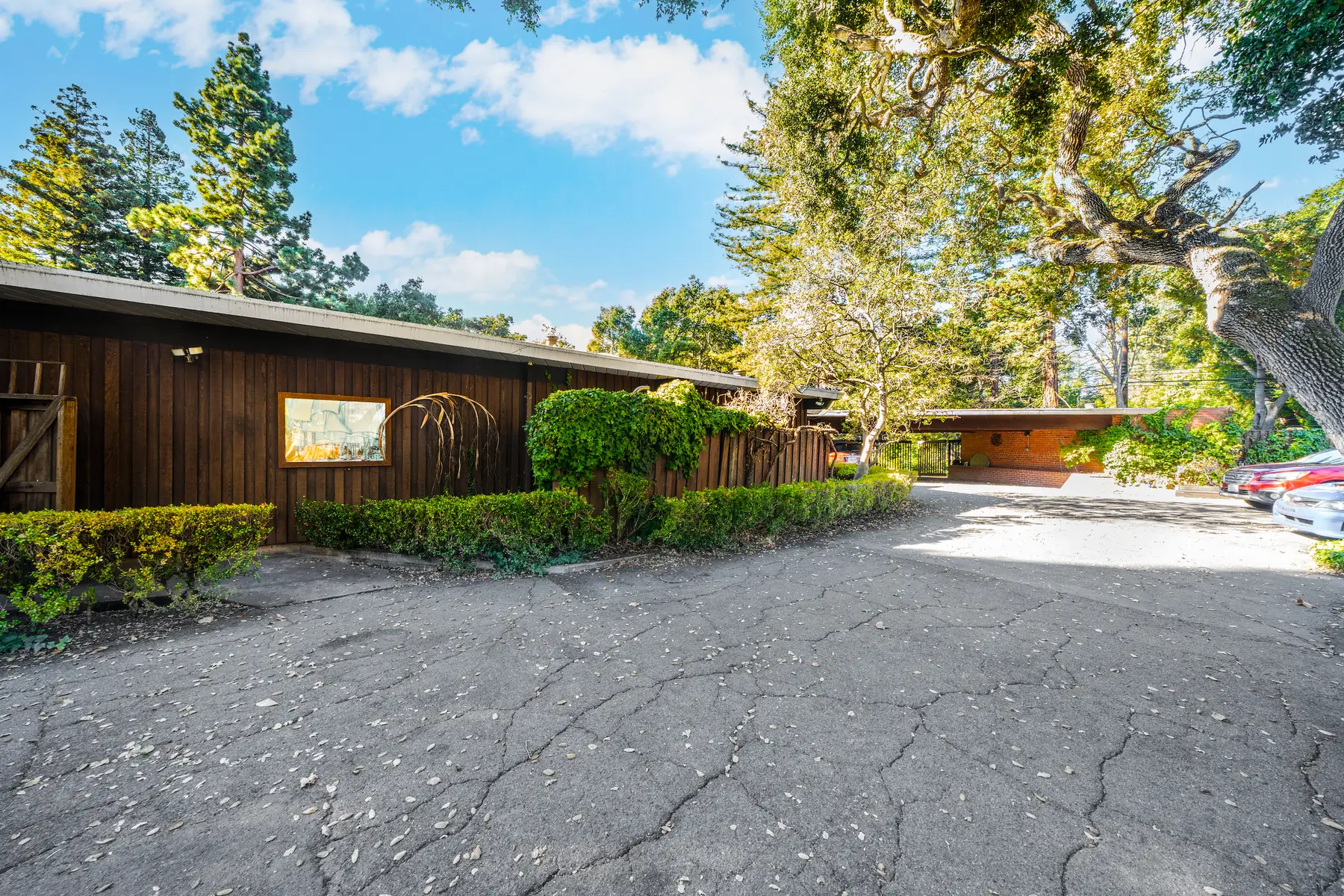
19 Irving Avenue
Before
Butter and eggs, then Wright.
Joseph Eichler was born in New York City on 25 June 1900 and took a business degree at New York University in 1920. In 1927 he moved to San Francisco, where his wife Lillian’s family had taken over Nye & Nissen, a wholesale dairy and egg business. He became its treasurer.
From 1943 to 1945 the Eichlers rented the Bazett House in Hillsborough, a Frank Lloyd Wright Usonian. (One source puts the start at 1942.) Everything after follows from those years.
The business
Three hundred ordinary houses first.
He began building in 1947 as the Sunnyvale Building Company, and put up about three hundred conventional houses before he hired an architect. Eichler Homes dates from 1949. It was Bob Anshen who persuaded him that architects should design the houses at all.
In 1950 Architectural Forum named his work subdivision of the year. In 1951 he brought in Jones & Emmons from Los Angeles, and from 1960 he contracted directly with Claude Oakland.
- Born
- New York, 25 June 1900
- Education
- NYU, business, 1920
- First building firm
- Sunnyvale Building Co., 1947
- Eichler Homes
- From 1949
- Houses built
- 11,000+ in California
- Died
- 1974
Sources: Eichler Network timeline; PAST Heritage; US Modernist; Wikipedia. The death date is given as 25 July 1974 by Eichler Network and 1 July by Wikipedia.
The stand
He sold to anyone.
Eichler sold houses to buyers of any race at a time when most American builders would not, and on 1 July 1958 he resigned from the National Association of Home Builders over it. He told House and Home that year:
“Eichler Homes in no way practices any kind of discrimination.”
Joseph Eichler · House and Home, 1958, via Eichler Network
In the same interview he allowed that most builders were probably no more in favour of discrimination than he was — but were bound by custom, or afraid of losing money.
Atherton
The house where he tested it.
In 1951 he built his own house on Irving Avenue, in the Lindenwood estate he was trying to develop, and lived there until 1965. It was where new ideas were tried before they reached the tracts. We listed it in 2024.
The end
Collapse, and a second firm.
Eichler Homes collapsed in the late 1960s. The sources date the end anywhere from 1965 to 1968; Eichler Network reports that Joe refused to file for Chapter 11. In 1966 he started again as Joseph L. Eichler Associates, working once more with Jones & Emmons and Claude Oakland. The Klingbeil Company bought that firm in 1972. He died in 1974.
His son Ned Eichler wrote the history of the whole trade, The Merchant Builders, published by MIT Press in 1982. It is on our reading list.
Questions we get asked
The ones that come up.
- How many Eichler homes were built?
- More than 11,000 in California, and three in Chestnut Ridge, New York, per US Modernist and Wikipedia.
- Was Joseph Eichler an architect?
- No. He was a builder and developer. His houses were designed by architects he hired — chiefly Anshen & Allen, Jones & Emmons and Claude Oakland.
- Where did Joseph Eichler live?
- In San Francisco from 1927, in the Bazett House in Hillsborough during the war, and at 19 Irving Avenue in Atherton from 1951 to 1965.
What we can do for you
Things worth asking us for.
Help us finish the record
If you hold something from 1951 to 1960, we would like to see it.
The 1953 Lindenwood brochure, a plan leaflet, a construction photograph, a letter from Eichler Homes — the documentary record for Atherton is thin, and a scan of what is in your drawer makes it better for every owner in town. We will credit you, or not, exactly as you prefer.
Talk to us
Atherton, specifically.
If you hold letters, photographs or sales material from Eichler Homes — especially anything from Atherton — we would like to see it, and to credit you for it.
Where to go next
Read these three.
The rest of the story